Renewable energy used to be a conversation mainly for companies with deep pockets and long planning horizons. That has changed — significantly. Here’s practical guidance for facility managers and business owners who want to go greener without overspending.
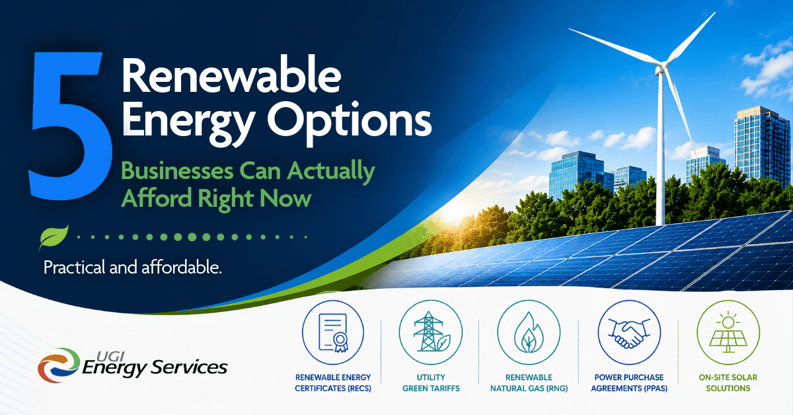
Between falling technology costs, evolving incentive opportunities, and increasingly competitive energy markets, small and mid-sized businesses across the Mid-Atlantic and Northeast can now access clean energy options that would’ve made financial sense only for Fortune 500 companies a few years ago. You don't need rooftop solar and a fleet of EVs to make meaningful progress. In some cases, the most affordable option can be set up in about 20 minutes.
Here are five options worth serious consideration, ranked roughly from the easiest and least expensive to the more involved, so you can decide where to start.
1. Renewable Energy Certificates (RECs)
- The fastest on-ramp to renewable energy — and one of the most misunderstood options
- Low upfront cost
- No infrastructure required
- Setup time: a few days
- Best for: businesses of all sizes
When a solar farm or wind turbine generates one megawatt-hour of electricity, it creates two things: the electricity itself, and a Renewable Energy Certificate. A REC represents the environmental attributes of that clean generation — and it can be purchased separately from the electricity.
By purchasing RECs, your business can make a recognized market-based claim that an amount of electricity equivalent to your usage was generated from renewable sources, even if those electrons aren't physically flowing to your building. This framework is widely recognized by the EPA, the Department of Energy, and many corporate sustainability standards.
From a cost standpoint, RECs are usually the most affordable entry point. Bundled RECs, purchased alongside your electricity supply, can add as little as 0.5 to 1 cent per kilowatt-hour to your bill. Unbundled RECs, purchased separately, can cost even less depending on market conditions.
WHAT TO WATCH FOR
Not all RECs are equal. Look for Green-e certified RECs to ensure they're verified, retired rather than double-counted, and traceable to specific generating facilities. Ask your energy supplier whether RECs are bundled into your contract or need to be added separately.
Relative cost: ● ○ ○ ○ ○ Very low — often under $500/year for a mid-size facility
2. Utility Green Tariff Programs
- Pay a modest premium to have your utility supply you with verified renewable power
- Low upfront cost
- Utility-backed program structure
- Setup time: 1–2 weeks
- Best for: businesses that want a simple, utility-managed option
Many utilities across Pennsylvania, New Jersey, Maryland, and other Mid-Atlantic states offer green tariff programs. These opt-in programs allow commercial customers to pay a small premium to have their electricity matched to renewable generation procured by the utility.
Unlike standalone RECs, these programs typically rely on the utility’s own renewable supply arrangements. For businesses that want something more structured than buying RECs on their own — without the complexity of a long-term power purchase agreement — green tariffs offer a practical middle ground.
You sign up, your bill goes up modestly, and your sustainability report gets a credible, utility-verified renewable claim.
The premium varies by utility and program but commonly runs between 1–3% above standard commercial rates. For a business spending $5,000 per month on electricity, that may mean an extra $50–$150, which many businesses consider worthwhile for the simplicity and sustainability value.
WHAT TO WATCH FOR
Availability depends on your utility territory. In deregulated states, check whether your energy supplier offers a comparable bundled green product. You may be able to get a similar outcome at a more competitive price than default utility service.
Relative cost: ● ● ○ ○ ○ Low — modest monthly premium, no capital outlay
3. Renewable Natural Gas (RNG)
- A clean alternative that works with your existing gas infrastructure
- No equipment changes required
- Compatible with existing gas systems
- Growing availability
- Best for: businesses with significant natural gas usage
Renewable Natural Gas, sometimes called biomethane, is produced by capturing methane from landfills, wastewater treatment plants, livestock operations, and food waste facilities. That captured gas is cleaned and injected into the existing natural gas pipeline network, where it becomes functionally identical to conventional natural gas.
For businesses that rely heavily on natural gas for heating, manufacturing processes, or food service, RNG is one of the few decarbonization paths that requires zero changes to equipment or operations. You're still using the same pipes, boilers, and burners — you're simply contracting for gas sourced from renewable feedstocks.
Pricing has historically been higher than conventional natural gas, but the gap has narrowed. With public policy incentivizing RNG production, pricing is becoming more competitive, especially for businesses that can sign multi-year contracts and benefit from fixed-price stability.
WHAT TO WATCH FOR
Like RECs, RNG works on a certificate-matching basis — you're not physically receiving molecules from a specific farm or landfill, but contracting for the verified environmental attributes of an equivalent volume. Ask your supplier about the source and certification (look for RNG Coalition or SCS certification) and how the environmental attributes are tracked and retired on your behalf.
Relative cost: ● ● ● ○ ○ Moderate — premium over conventional gas, with pricing becoming more competitive over time
4. Power Purchase Agreements (PPAs)
- Lock in long-term renewable pricing — often below market rates
- Price certainty
- Potential savings versus future market prices
- Setup time: several weeks to several months
- Best for: larger energy users with stable demand
A Power Purchase Agreement is a long-term contract between a business and a renewable energy generator — typically a wind farm, solar project, or hydro facility. The business agrees to buy electricity from the project at a fixed price per kilowatt-hour over a set term, often 10–15 years.
PPAs appeal to many businesses for a simple reason: economics. Solar and wind have have fallen enough that some PPAs are priced below average commercial electricity rates in the Northeast. Locking in a fixed renewable rate can help protect your business from future price volatility while supporting verifiable renewable energy claims.
Virtual PPAs, also called financial or off-site PPAs, have become especially accessible for mid-market businesses. In a virtual PPA, you don't physically receive the power. Instead, you receive the RECs from the project and settle financially based on the difference between your contracted price and the market price. The risk and structure are more complex than simpler options, but the potential price benefit can be meaningful.
WHAT TO WATCH FOR
PPAs usually require enough energy volume and financial stability to be worthwhile. Many projects set minimums around 1–5 MW of annual demand. If your total electricity spend is under $200,000 annually, a PPA may add more complexity than it's worth. Aggregated PPAs — where multiple smaller businesses combine their load — are an emerging option worth exploring.
Relative cost: ● ● ○ ○ ○ Can be cost-neutral or savings-positive over contract term
5. On-site Solar with Financing or Lease
- Generate your own electricity with options that may require little to no upfront capital
- Federal tax incentives may be available
- Strong long-term savings potential
- Setup time: 3–9 months
- Best for: businesses that own their facilities
On-site solar has a reputation for large capital requirements — but that's increasingly no longer the story. Two structures have made solar accessible to businesses that can't or don’t want to invest $300,000 upfront: solar leases and solar loans.
With a solar lease, a third-party developer owns, installs, and maintains the panels on your roof. Your business pays a fixed monthly lease payment, often lower than your current electricity costs for that portion of your load, and uses the electricity the system generates. You don't own the asset, but you also avoid the upfront capital risk.
With a solar loan, your business owns the system from day one, which may allow you to capture the full value of the federal Investment Tax Credit, currently up to 30% for eligible projects under current law, along with any applicable state incentives. Monthly loan payments are often structured to be offset by your electricity savings, which can produce net-neutral or net-positive cash flow from year one.
For businesses that own their facilities and have south-facing or flat roof space, on-site solar is worth pricing out— if only to understand the economics. Payback periods in the Northeast have come down significantly and now commonly range from 5–8 years for owned systems.
WHAT TO WATCH FOR
Roof condition, age, and structural load capacity all matter. If a roof replacement is coming in the next 5 years, that timing changes the economics. Also factor in whether your facility is owned or leased — a 10-year solar lease on a property with 4 years left on the lease agreement is a problem waiting to happen.
Relative cost: ● ● ● ● ○ Higher upfront or financed cost — but often the strongest long-term ROI
The bottom line
Renewable energy doesn’t have to be an all-or-nothing decision. Many businesses start with a combination of options — for example, RECs in the near term, an RNG contract for their gas load, and a solar evaluation running in parallel for a future budget cycle. The key is to start somewhere rather than waiting for the perfect solution.
If you're not sure which option fits your situation, the fastest way to find out is to talk through your energy spend, your facility type, and your sustainability goals with someone who knows the market. That conversation usually takes less time than you'd expect — and it costs nothing.
Not sure where to start? Let one of our sales representatives walk you through your options. Contact us today!