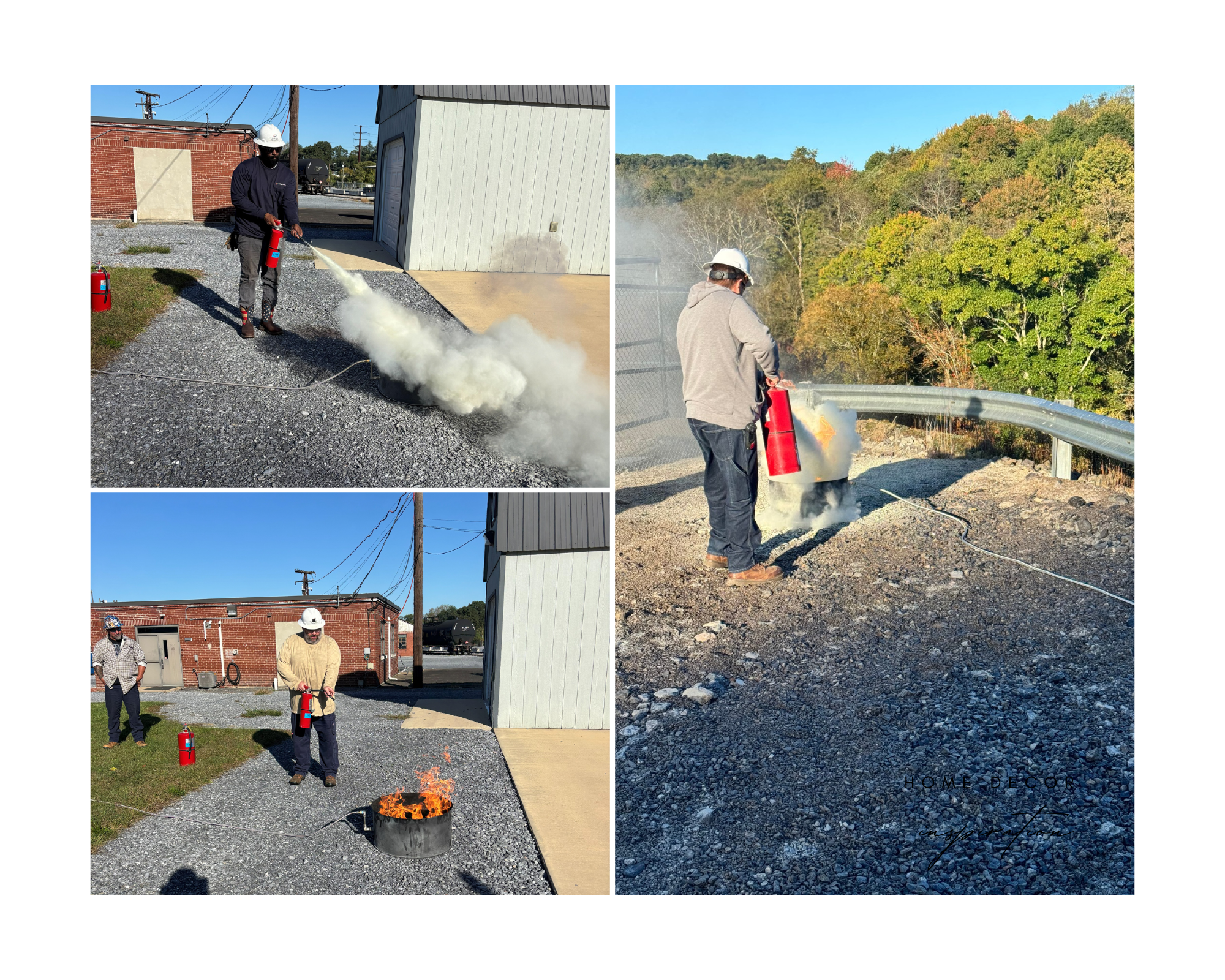
Last month was Emergency Preparedness Month, and our October safety meetings combined classroom learning with hands-on practice. Each meeting started with a short presentation covering the classes of portable fire extinguishers, how to approach an incipient fire, when to fight a fire versus evacuate, and the PASS method. Then more than 150 employees put that knowledge to work by discharging a fire extinguisher at a live fire. Pulling the pin and feeling the extinguisher work builds confidence in a way no slide deck can.
A Special Thank You to Our Temple Operations Team
None of this would have been possible without the Temple Operations employees who took the time to fabricate three propane-fueled burn pits. Their craftsmanship gave us a safe, contained fire target that we could light, control, and shut off on demand. Thank you for the effort, skill, and care put into this safety exercise. Every person who trained benefited from the team's work.
 Know Your Fire Classes
Not every extinguisher works on every fire. Extinguishers are labeled by the class of fire they are rated to fight:
- Class A: Ordinary combustibles such as wood, paper, cloth, and trash
- Class B: Flammable liquids and gases such as gasoline, oil, and propane
- Class C: Energized electrical equipment such as appliances, wiring, and panels
- Class D: Combustible metals, mostly found in industrial settings
- Class K: Cooking oils and fats, common in commercial kitchens
Most multipurpose dry chemical extinguishers are rated ABC, which makes them a solid all-around choice for the home and workplace. Always check the label to confirm what yours is rated.
Fight or Evacuate?
An extinguisher is only meant for an incipient fire, which is a fire in its earliest stage, small and contained, such as a wastebasket or a small pan on the stove. Before you reach for one, ask yourself:
- Is the fire small and not spreading?
- Have others been alerted and has 911 been called?
- Do I have a clear exit behind me?
- Do I have the right extinguisher for this type of fire, and do I know how to use it?
If the answer to any of these is no, or if the room is filling with smoke, the fire is growing, or you simply feel unsure, get out and call 911. Property can be replaced. You cannot.
Remember PASS
When you have decided to fight a small fire, use the PASS method:
- Pull the pin
- Aim the nozzle at the base of the fire, not the flames
- Squeeze the handle
- Sweep side to side across the base until the fire is out
Stay about 6 to 8 feet back and keep your exit at your back. Once the fire appears out, keep watching it in case it reignites.
At-Home Tips
- Kitchen: Keep an extinguisher near an exit path, not right next to the stove. If a fire starts on the cooktop, you need to reach the extinguisher without reaching through flames. Never use water on a grease fire. Slide a lid over a pan fire and turn off the heat.
- Garage and workshop: Keep an ABC extinguisher near the door, away from fuel cans, solvents, and the water heater. Workshops often have flammable liquids, so confirm the label includes Class B.
- Every level of your home: Keep at least one extinguisher on each floor, and consider one near the bedrooms.
- Keep it accessible: An extinguisher is only useful if you can get to it in seconds. Don't let it get buried behind storage bins, coats, or clutter, and keep the path to it clear.
- Make sure everyone knows where the extinguishers are: Walk everyone in your household through where each extinguisher is kept, and how to use it. In an emergency, nobody should have to search.
Inspect and Maintain
- Check the pressure gauge monthly. The needle should be in the green.
- Confirm the pin and tamper seal are intact and the hose and nozzle are free of cracks or blockage.
- Look for dents, rust, or corrosion on the cylinder.
- For dry chemical units, turn the extinguisher upside down and give it a gentle shake monthly so the powder doesn't pack at the bottom.
- Check the manufacturer's label for the service life. Many disposable units should be replaced after about 10 to 12 years, and rechargeable units need professional servicing.
- If an extinguisher has been used, even briefly, replace or recharge it right away.
Carry it Forward
Emergency Preparedness Month may be over, but the preparation does not have to stop. Take five minutes this week to walk through your home and find your extinguishers. Check the gauges, make sure everyone in the house knows where they are, and talk through your escape plan. A little preparation now is what makes the difference when seconds count.
Thank you to everyone who participated in our October training, and to Temple Operations team for making it possible.