There’s encouraging news for natural gas customers heading into winter. The U.S. Energy Information Administration’s October 6 Winter Fuels Outlook 2026-27 projects lower natural gas prices and lower average household natural gas spending nationally, with an especially favorable outlook for the Northeast.

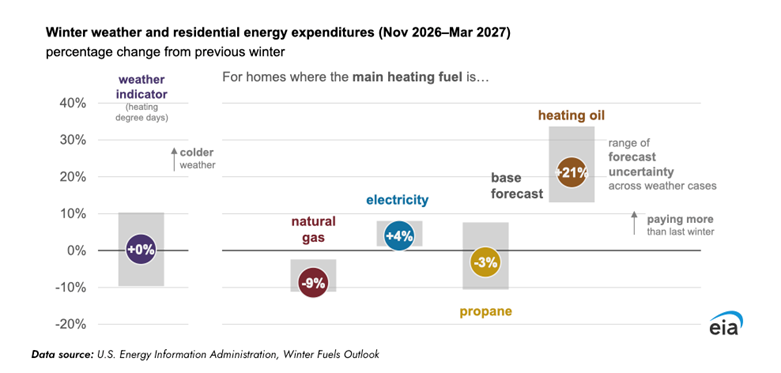
The broader picture varies by fuel and region. While households heating with natural gas or propane are expected to spend less, those using electricity or heating oil could face higher costs. Here are five takeaways from EIA’s outlook for November 2026 through March 2027.
1. Natural gas offers encouraging news
Natural gas—the most widely used residential space heating fuel in the United States—heads into winter with a favorable cost outlook.
EIA projects average winter natural gas expenditures of $640 for households that use it as their primary heating fuel, a 9% decline from last winter. National average residential natural gas prices are also expected to fall 9%, while consumption remains approximately unchanged.
Lower prices, combined with similar or warmer weather, are expected to reduce natural gas spending across the Northeast, Midwest, and South. The West is the exception: substantially colder weather is projected to increase consumption enough to outweigh lower prices.
For many households, the forecast points to welcome relief in winter energy budgets. The size of that relief will depend on local conditions and the prices individual customers pay.
2. Northeast customers could see savings
The Northeast outlook is particularly encouraging for households heating with natural gas. EIA projects average winter natural gas expenditures of $879, down 14% from last winter, reflecting both lower prices and reduced heating demand.
Following a relatively cold winter last year, EIA expects 12% fewer heating degree days in the Northeast. Heating degree days measure weather-driven heating needs; fewer generally indicate less demand for space heating.
Regional residential natural gas prices are forecast to decline 5%, while consumption is expected to fall 10%.
Those projections offer a positive starting point for winter planning in a region relevant to many UGIES customers. Weather remains uncertain, however. EIA also evaluates scenarios with 10% more or fewer heating degree days than its base forecast to illustrate how conditions could change.
3. Other fuels face mixed conditions
The favorable natural gas outlook is part of a broader picture in which costs move differently across fuels.
EIA expects propane expenditures to decline 3% nationally, to $1,246, and 15% in the Northeast, to $1,687. Households heating primarily with electricity are projected to spend 4% more nationally, averaging $1,196, although Northeast electricity expenditures are forecast to decline 3% as milder weather reduces consumption.
Heating oil faces the largest projected increase: average winter expenditures of $2,115, up 21%. EIA attributes that increase to higher crude oil and distillate prices, reduced global refining activity, and tight supplies.
These figures describe different groups of homes, not the cost of operating different heating systems in the same home. EIA cautions against using its expenditure averages alone to decide whether switching fuels would save money.
4. What the outlook means for businesses
For commercial and industrial customers, the natural gas outlook provides encouraging context—but not a direct forecast of business energy costs.
EIA’s Winter Fuels Outlook focuses on residential customers. Its household spending estimates should not be applied to manufacturing facilities, offices, hospitals, or other commercial operations.
Still, the market themes offer a useful framework for planning. Lower projected residential natural gas prices are a positive signal within the outlook, while weather and changing market conditions remain important variables.
Businesses can put those trends into perspective by reviewing expected consumption, supply contract terms, and exposure to price changes. A facility using natural gas for year-round production will have a different demand profile from a building primarily using it for seasonal heating. The most useful planning approach connects the market outlook to the organization’s actual energy needs.
5. Your bill depends on more
For residential readers, lower projected natural gas spending is good news, but individual results will vary.
Home size, insulation, heating equipment efficiency, local weather, and supply arrangements all affect actual costs. EIA’s estimates also include other uses of a home’s primary heating fuel, such as natural gas used for cooking or water heating.
The timing of price changes matters, too. EIA explains that residential natural gas and electricity prices generally lag wholesale markets because of rate-setting schedules, previously purchased supply, and other costs. A change in wholesale prices therefore may not appear immediately—or proportionately—on a customer’s bill.
EIA will update its outlook throughout the winter. For now, the forecast offers an encouraging starting point for natural gas customers, particularly in the Northeast.
If you have questions about energy markets heading into winter, reach out to the UGIES team to see how our experts can help.